

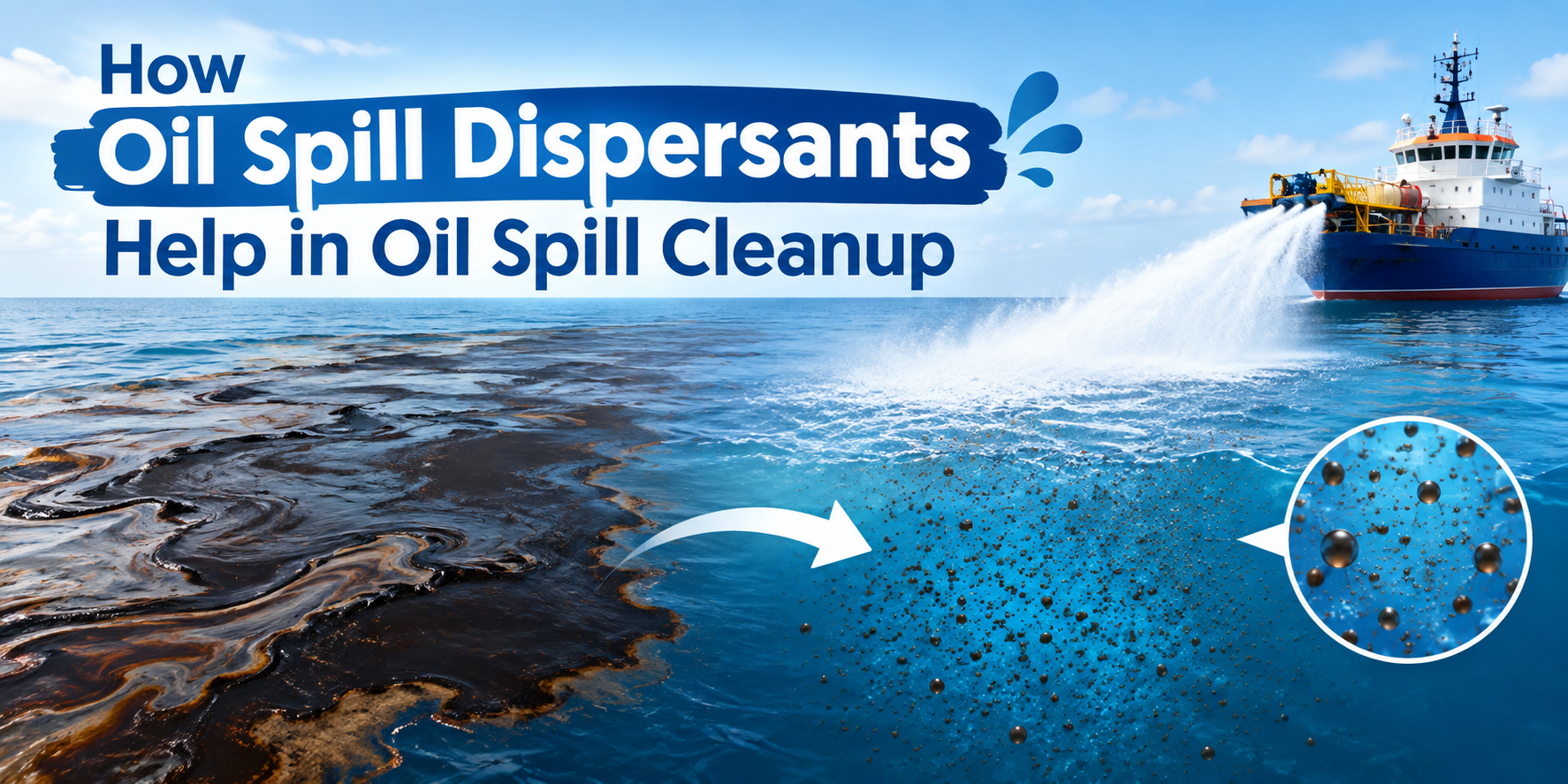
Oil spills pose various dangers to industries, ports, marine operations, refineries, and many other industries that work with petroleum products. Once oil makes its way to water and other surfaces, it can rapidly spread, making mechanical recovery of oil very difficult. To combat the problem of oil contaminating the water bodies, oil spill dispersant is made to break up the oil layer into smaller droplets, thus helping in solving the problem by dispersing oil.
What Are Oil Spill Dispersants?
Oil spill dispersants are chemical solutions especially formulated for the treatment of oil pollution in the seas, oceans and other water bodies. They contain active materials that operate at the interface between oil and water. The timely application enables the lowering of the surface tension in the oil, allowing for the separation of the oil layer into tiny droplets. Due to this, the droplets can be dispersed with the water instead of remaining in one place on the surface of the water.
Why Oil Cleanup Is Necessary
Oil spreads with ease throughout the water, and it can harm marine life, posing issues for ports, offshore operations, coastal regions, and other businesses.
- Oil Slick Problem
We call it an oil slick when oil spreads on the surface of water. The slick can spread as a result of wind, currents, and waves which can make the rescue operation difficult.
- Why Traditional Methods Fall Short
The boom and skimmers are ordinary equipment used to contain the oil and recover it. However, many factors, like the weather, waves, size of the spill, and type of oil, can negatively influence their effectiveness. In such conditions, oil spill dispersant can serve as an effective solution instead of conventional mechanical techniques.
Science Behind Oil Spill Dispersants
Dispersants act due to the relationship of water, oil, and surface-active agents. If rightly used, they assist with breaking the continuous film of oil into small particles, which will be dispersed within the body of water.
- Breaking Surface Tension
These active ingredients reduce the interfacial tension of oil and water, which makes it easier to break the oil into small droplets with the help of wind or other water movement.
- Creating Micro-Emulsions
The oil is transformed into small globules instead of remaining one slick. This means the concentration of oil on the water surface is reduced, leading to spreading of oil over the upper water column.
- Quickens Natural Degradation
Due to the smaller size of oil globules, there is more surface area that allows for easier interaction of microorganisms with oil, thus promoting natural degradation under appropriate conditions
Variants of Foamer Oil Dispersant
Foamtech Antifire Company provides its clients with Foamer Oil Spill Dispersant in two types, namely Type II and Type III.
- TYPE II
Type II is dilutable concentrate, and with foamtech’s specifications, it is usually diluted in 10% finale with seawater before use. Depending on the contamination levels and the area of the application, Type II could be used either as a pure concentrate or as a diluted product.
- Type-III
Type III is supplied in the concentrate form and the pure application form, and deciding on the type to use would depend on the spills in question and the technical specifications of the products.
Conclusion
Cleaning up an oil spill takes time, and efforts are put in place to ensure that the particular type of oil which is involved in the spill, the location of the accident, the nature of the environment, as well as the method of response are considered. An oil spill dispersant is capable of helping in the process by converting the oil from a big drop into smaller droplets in water. Foamtech Antifire is a reliable supplier of multiple types of oil spill dispersants approved by CSIR-National Institute of Oceanography and Indian Coast Guard.